
How to Identify Authentic Kerala Pickles – A Complete Buyer’s Guide
How to Identify Authentic Kerala Pickles – A Complete Buyer’s Guide
Kerala pickles have a problem that most buyers do not realise until they taste the difference. The demand for authentic Kerala achar has grown significantly driven by NRIs abroad, food enthusiasts discovering regional Indian cuisine, and health-conscious buyers looking for preservative-free options. But the market is full of products labelled “Kerala pickle” or “homemade style” that use ingredients and methods that have nothing to do with actual Kerala pickle tradition.
This guide gives you the specific markers of an authentic Kerala pickle so you can identify the real thing every time.
Check the Oil First
The single most reliable indicator of authentic Kerala pickle is the oil. Traditional Kerala achars are made in pure coconut oil – not mustard oil, not refined sunflower oil, not palm oil, not a blend.
Coconut oil serves two functions in Kerala pickle. It is the cooking medium that carries the spice flavour into the main ingredient. And it is the preservation medium – submerging the main ingredient in coconut oil protects it naturally without chemical preservatives. The coconut oil in a properly made Kerala pickle will be visible in the jar and may solidify slightly in cooler temperatures. This is normal and is a sign of real coconut oil, not a defect.
If the ingredient list says mustard oil – you have a North Indian style pickle, not Kerala style. If it says refined vegetable oil or simply “edible oil” without specifying – it is almost certainly palm oil or sunflower oil. Authentic Kerala pickle says coconut oil and means it.
Check the Souring Agent
North Indian pickles use vinegar, lemon, or raw mango sourness as the acid element. Authentic Kerala pickles – specifically non-veg pickles like beef pickle, fish pickle, and prawn pickle – use kudampuli, also called Malabar tamarind or Garcinia cambogia. Kudampuli is a dried fruit from the Western Ghats that gives a mild, fruity sourness completely different from vinegar’s sharp acidity.
When you read a Kerala pickle label and see vinegar in the ingredients – it is not authentic Kerala style. When you see regular tamarind instead of kudampuli – it is a substitute that changes the flavour profile. The genuine marker is kudampuli or kudampuli extract listed explicitly.
Note: mango pickle (manga achar) is the exception – raw mango provides its own sourness and kudampuli is not always used. For beef pickle, fish pickle, and prawn pickle specifically – no kudampuli means it is not the authentic Kerala version.
Check the Spice Form
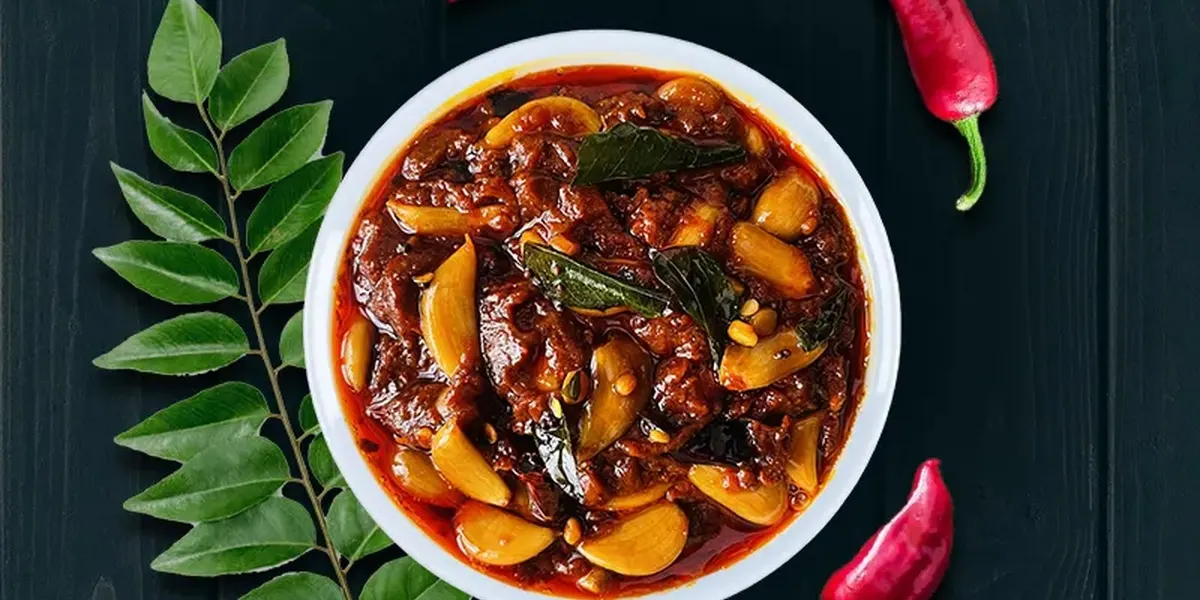
Authentic Kerala pickles use whole spices – mustard seeds, fenugreek seeds, dried whole red chillies, whole black peppercorns, curry leaves. These spices are visible in the jar. You can see them floating in the oil.
Commercial pickles use ground spice paste or spice powder mixed into the main ingredient. The result is a uniform, smooth coating with no visible whole spices. This is easier to produce at scale but gives a completely different flavour – more immediate, less complex, fading faster than whole spice versions.
When you open a jar of authentic Kerala pickle, you should see whole spices in the oil. If the oil is uniformly coloured without any visible whole spices – the spices were ground, which is a production shortcut that changes the character of the pickle.
Check for Preservatives
Authentic Kerala pickle uses no chemical preservatives. The natural preservation comes from the combination of coconut oil, salt, and the acidity of kudampuli. This combination has kept Kerala pickles shelf-stable in home kitchens for centuries without chemicals.
Look for these on the label: sodium benzoate, potassium sorbate, acetic acid in large quantities, or citric acid. Any of these indicates the natural preservation method was compromised – the coconut oil was reduced or the kudampuli was eliminated, requiring chemical backup.
A genuinely clean Kerala pickle ingredient list reads: the main ingredient, coconut oil, salt, whole spices listed individually, kudampuli. Nothing else.
Check the Shelf Life Claim
A common misconception is that preservative-free food has very short shelf life. Authentic Kerala pickle made in coconut oil with kudampuli has a shelf life of two to three months at room temperature – entirely through natural preservation. If a product claims to be preservative-free but lists a twelve-month or eighteen-month shelf life – either chemical preservatives are present under different names or the claims are inaccurate. Two to three months is the honest shelf life for a genuinely preservative-free Kerala pickle.
The Texture Test for Non-Veg Pickles
For beef pickle and fish pickle specifically – the texture of the main ingredient tells you a great deal about how it was made.
Authentic Kerala beef pickle has tender but intact pieces of beef. The beef holds its structure after cooking because it was fried first, then simmered in spiced oil, then allowed to rest in the oil. Factory-made versions often have beef that has broken down into shreds or mush – a sign of pressure cooking or overcooking shortcuts.
Fish pickle should have intact pieces of fish that hold up when you spoon them out. If the fish has disintegrated into the oil – either the wrong fish variety was used or the cooking method was wrong.
Where to Buy Authentic Kerala Pickles
Small producers making Kerala pickle the traditional way – coconut oil, kudampuli, whole spices, no preservatives – are increasingly available online for both domestic and international delivery. The key is knowing what to look for on the label and trusting producers who are transparent about every ingredient.
For a complete range of authentic Kerala pickles made to these exact standards – beef pickle, fish pickle, mango achar, prawn pickle – available for delivery across India and internationally, visit authentic Kerala pickles online.


